
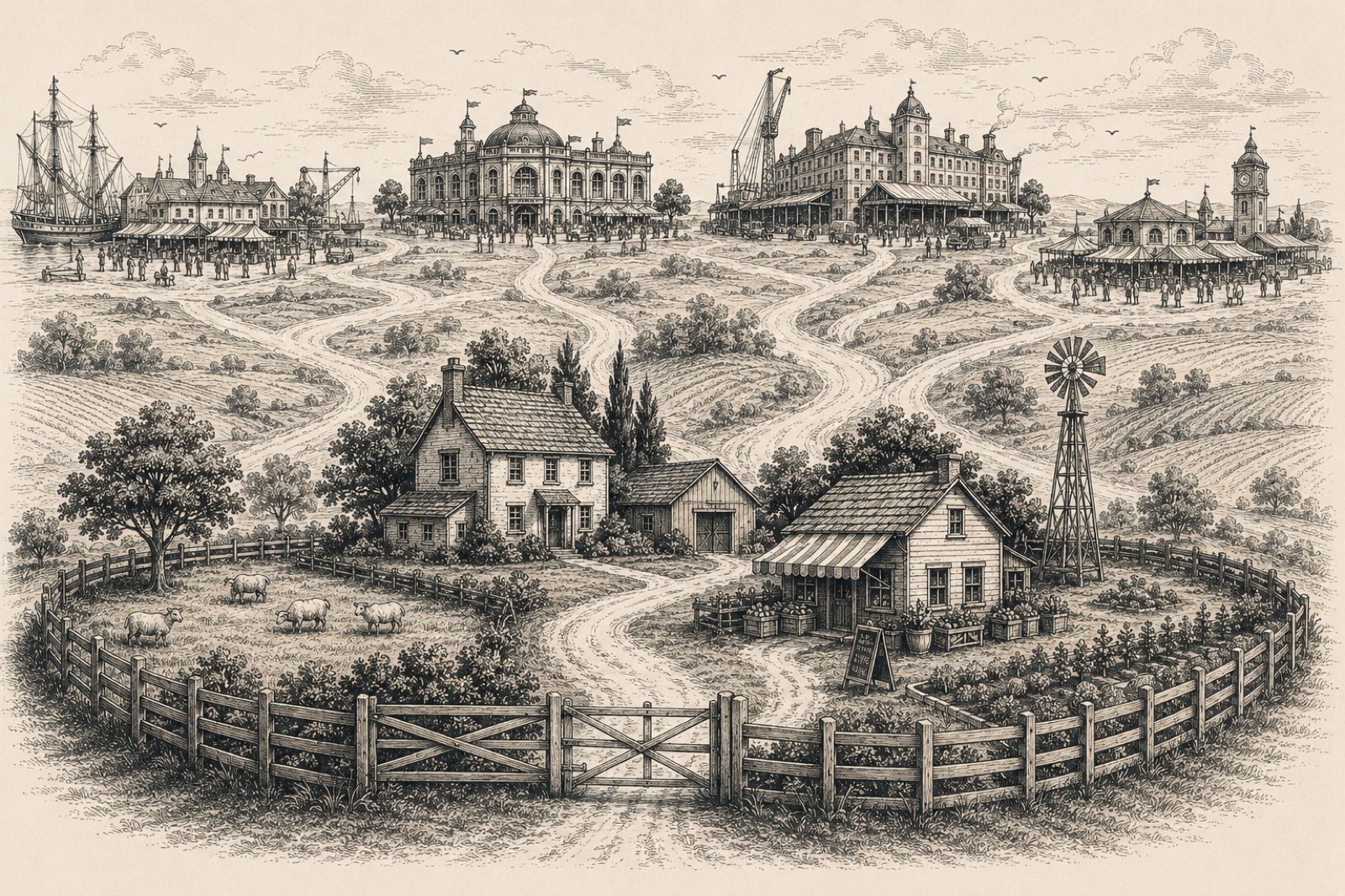
To understand the internet, you first have to understand rent, and you have to understand the land registry.
They look like completely different things. But the principle is always the same. Money flows to the people who understand land - who understands real estate. That has been true for centuries, and it is still true today. The only thing that has changed is what "land" means.
Instead of land, instead of physical houses, we now have VPS and Cloudflare. Cloudflare is the new department of lands - the registry that says who owns what and where to find it. A VPS is the house that you actually build and live in. It is a whole new world, and you must understand it. Otherwise, one day, you risk losing everything.
The risk nobody talks about
What people aren't talking about enough is how many of them are losing their entire livelihood - or a huge chunk of their income - because they lost access to something digital. A website. A Facebook page. An Instagram account.
Most recently we've seen huge waves of people lose access to their AdSense and YouTube accounts - accounts that used to bring in tens of thousands of pounds every month. Gone.
The risk is very real. It affects real money. These are real assets. They just happen to be digital. And it is incredibly important that we learn about this and understand it.
Marketplaces are little countries
The word "marketplace" sounds strange, so let's think about a farmers market for a moment.
Imagine you're a farmer in the countryside selling cheese. You're in Cambridge, in the middle of nowhere, and nobody comes to you. So what do you do? You go into the city. In Cambridge there's a big market; in London there are a few huge ones.
Every market is different. Some are bigger than others. Some have more old people, some are more hippy, some are pure high-end. The more crowded it is, the harder it is to get a stall.
Facebook is like that. Instagram is like that. Google Maps, Amazon, eBay - all of them. They are huge marketplaces. Or really, they are little countries that let you in provided you follow certain rules. Once you're in, you can sell there and speak to the residents.
But at the end of the day, you have to acknowledge one thing: the market always has an owner. It has a board of directors and decision makers who decide who comes in and who goes out. They have rules - and they can change those rules whenever they like.
People sell on Facebook for years and forget this. And here's the pattern: the rules are very easy at first, but once a market gets crowded, the rules get stricter and stricter to filter out the bad actors. Call it "one person ruins it for everyone" if you like - but it is inevitable. It is going to happen anyway.
Understand their incentives before you blame them
So what's the way out?
The first real step is to understand what these institutions actually are. What are their incentives? How do they earn money? What do they give, and what do they take?
As long as you and them have a genuine win-win deal in place, you'll mostly be fine. But if you try to screw them over, you'll be the first one to get screwed.
The AdSense situation is exactly this. Lots of people flooded the platform with AI-generated content, thinking it was easy, quick money. But if you were Google, would you want low-effort content on your platform forever? You're the one who gets blamed for hosting trash - not the creators.
So what did Google do? They didn't delete the channels. They disabled monetisation due to unusual traffic. And instead of starting again with a clean sheet and doing it properly, people went hunting for a loophole to restore their accounts. That's not very smart.
Google wants good content so it can keep traffic - not for a few days, but for years - so it can sell ads and build other revenue on top. If you post good, authentic, quality content, you'll be fine.
Think about it from the other side. If you owned the market, would you want someone selling counterfeits and low-quality junk to your residents, just because they paid an entry fee? Of course not.
Like it or not, this is the new reality. New rules, on a new kind of land.
Build your own farm shop
Here's the part farmers eventually understand: once you've earned a little money at the market, you put some of it back into building your own nice little farm shop, right there on the farm. Maybe a little cafe too, so people have a reason to make the trip out to the middle of nowhere.
And then you let the map people know you exist - that's where Google Maps comes in.
The marketplace is how you get discovered. Your own shop is how you stop being a tenant.
Cloudflare, and the danger of not owning your domain
This is the dangerous part: when you don't understand the ownership of your domain.
Your domain is how people find you. And most people - especially small business owners - leave it entirely to their web developer to "take care of it" as part of the package. They end up with no control whatsoever. Needless to say, that is extremely dangerous.
The good news is that it isn't hard:
- Create your own Cloudflare account and buy your own domain. This is your entry in the registry. It should be in your name.
- Get a GitHub account and own your source code. The thing that runs your business should belong to you.
- Get a DigitalOcean (or similar) VPS and keep your own backups on your own server and system. (If you want to see the other extreme of this, look up r/DataHoarder on Reddit.) The point is simple: keep our data our thing.
If you've ever used WhatsApp, think about how easy it is to lose all your messages the moment you change your phone. And yet there are companies - I know of several - running multi-million pound deals and operations out of WhatsApp groups as their single source of truth.
That should make you nervous. And it should make you act.
The takeaway
The land changed. The rules of ownership did not.
Use the marketplaces - they're how the world finds you. But understand that you are a guest there, and build something you actually own alongside them: your domain, your code, your server, your data. That's the difference between a business that can be switched off by someone else's board of directors, and one that's genuinely yours.
Otherwise, one day, you risk losing everything.